Why Your Knee Hurts Is Rarely Only About Your Knee
Knee pain sends more people through our doors than almost any other complaint, and in a large share of those cases the knee itself is not where the problem started. The knee is a hinge caught between two joints that rotate, the hip above and the ankle below, and when either of those stops moving well the knee absorbs what they no longer handle. We see this constantly in gait analysis, where a patient presenting with anterior knee pain turns out to have weak hip abductors (gluteus medius) allowing the femur to drop inward into a knock-knee position (genu valgum) that grinds the kneecap against the thigh bone at the patellofemoral joint every single step.
That is why an approach aimed only at the painful spot tends to buy a few comfortable days and nothing more. It is also why we treat knee pain as a movement problem first and a pain problem second.
But pain has to come down far enough for a patient to move, and that is where laser therapy has earned a place in how we work.
What EMVITAL Actually Does
We now offer EMVITAL by BTL at Therapeutic Rehab Specialists as part of our laser therapy program. EMVITAL is an FDA-approved medical device for the temporary relief of muscle and joint or arthritis pain and stiffness, built on what BTL calls TriHIL technology: a 1064 nm infrared laser delivered through a hands-free applicator that is placed directly on the skin and produces controlled topical heating, gently raising the temperature of the tissue in the treated area. The knee sits squarely on BTL’s list of treatment areas, alongside, fittingly enough, the hips and ankles whose mechanics so often put it there in the first place.
That controlled heating supports four things: temporary relief of muscle and joint pain and stiffness, relief of minor arthritis pain, a temporary increase in local blood circulation, and temporary relaxation of muscle spasms.
It is worth being precise about what that means and what it does not. This is not a treatment that rebuilds cartilage or reverses arthritis, and any clinic telling you otherwise is selling you something. What it does is create a window in which a stiff, guarded, painful knee moves more comfortably than it did an hour earlier, and in that window we can do the loading, the strengthening and the movement retraining that actually changes the outcome.
This is not a treatment that rebuilds cartilage or reverses arthritis. What it does is create a window, and what you do inside that window is what changes the outcome.
The Knees We See It Help Most
Minor arthritis pain in the knee. The stiffness that is worst in the first ten minutes of the morning and again after sitting through a long meeting.
Patellofemoral pain. Pain at the front of the knee, worse on stairs and hills, common in runners and in anyone whose hip strength has not kept pace with their mileage.
Post-surgical stiffness. Knees that are healing correctly but have become guarded and reluctant, where a session of deep, comfortable warming before therapy means a patient tolerates far more range of motion than they otherwise would.
Soft tissue irritation around the joint. Tendon and muscle complaints where the thigh muscles anchor above and below the kneecap (quadriceps and patellar tendons) or along the outside of the thigh (iliotibial band).
What a Session Involves
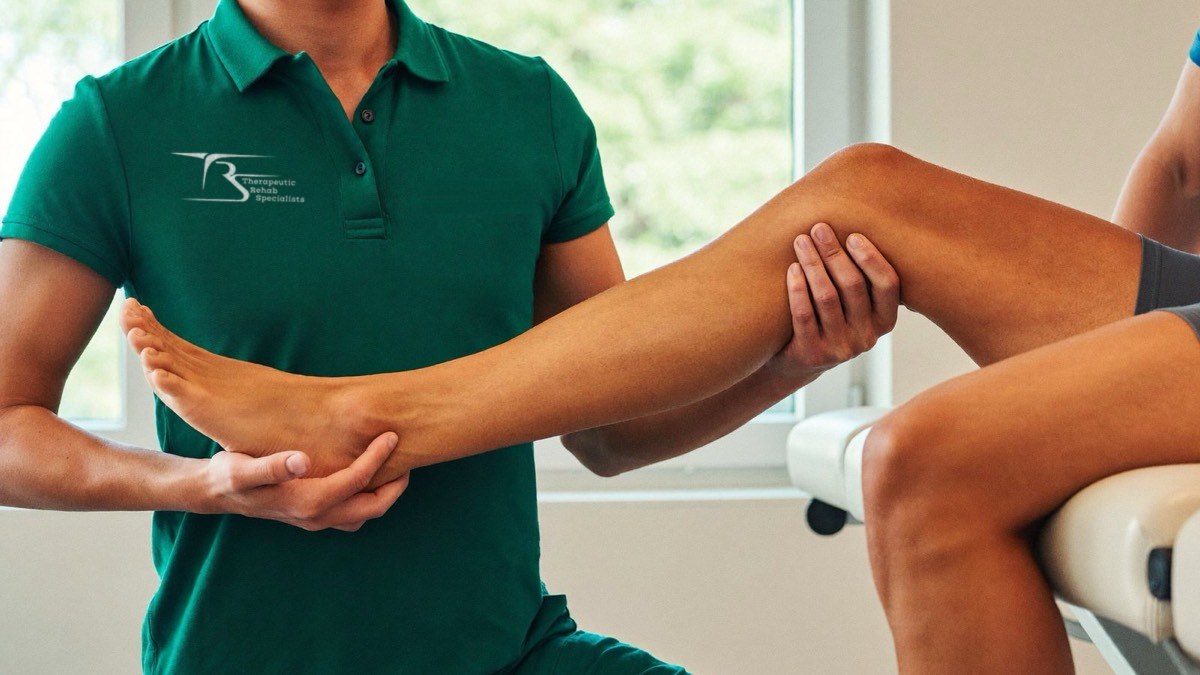
The applicator is placed directly on the skin over your knee, you put on the protective eyewear we supply, and you lie still. Most patients describe a deep warming sensation and nothing more than that, and in the study BTL reports, 97% of patients found the treatment comfortable. You also hold a Therapy Discomfort Button for the entire session, a detail I genuinely appreciate: the machine cannot start without it, and pressing it pauses the therapy, which puts the comfort ceiling in the patient’s hand rather than the operator’s.
Sessions run anywhere from four to thirty minutes, there is no downtime, and you can drive yourself home and return to work immediately. BTL recommends a minimum of four sessions, spaced roughly two to ten days apart, though your provider will build the plan around your symptoms and your goals rather than around a protocol sheet.
When It Is Not the Right Choice
We will tell you if it is not appropriate, because the treatment is suitable for all skin types but suitability still gets established by an assessment, never assumed. Patients who are pregnant, who have electronic implants in the treatment area, who have an active infection at the site, who have received corticosteroid injections there within the last three months, who are on anticoagulant (blood-thinning) therapy, or who have a history of cancer are not candidates, and your history gets reviewed before anything is switched on. If your knee pain is coming from something that needs an orthopedic consultation rather than conservative care, you need to hear that from us early rather than after eight weeks of therapy that was never going to work.
One Tool, Not the Whole Plan
Laser therapy is one tool. It sits alongside manual therapy, ultrasound guided dry needling, and the movement work that addresses why the knee was overloaded to begin with, and it is most useful as part of that plan rather than instead of it.
Dr. Pribila is available in both our Lakeland and Brandon offices. Call (813) 876-8771 for more information or to schedule an evaluation, and check us out on the web at: https://therapeuticrehabspecialists.com/