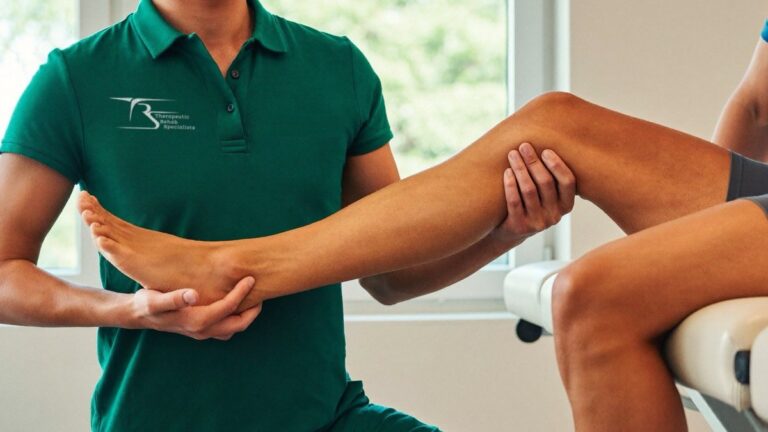
Why Jaw Pain Is Rarely Only About the Jaw
Jaw pain brings patients into our clinics later than almost any other complaint, partly because nobody is quite sure who to see for it and partly because the pain wanders into the temple, the ear and the teeth in ways that make it hard to point at. The joint is the temporomandibular joint (the hinge where the lower jaw, or mandible, meets the temporal bone just in front of the ear), one of the most heavily used joints in the body, cycling thousands of times a day through chewing, talking and swallowing and, for many, through hours of nighttime clenching and grinding (bruxism) they never notice.
The jaw almost never acts alone. The muscles that close it, the masseter (the thick muscle that bulges at the angle of the jaw when you clench) and the temporalis (the fan-shaped muscle spanning the side of the skull), share their neurological wiring with the upper cervical spine, and the forward-head posture we see in nearly every desk worker loads the small muscles at the base of the skull (suboccipitals) in ways that change how the jaw rests and tracks when it opens. That is why so many patients we treat for headaches and neck pain turn out to have jaw involvement, and why a large share of TMJ patients get only partial relief until somebody finally examines the neck.
What EMVITAL Does for the Jaw Muscles
We now offer EMVITAL by BTL at Therapeutic Rehab Specialists, and the jaw is where its design genuinely matters. Most laser therapy tools are handheld wands, which means someone is pressing an applicator against a masseter already tender enough to flinch from a thumb. EMVITAL delivers a 1064 nm infrared laser, using BTL’s TriHIL technology, through a hands-free applicator placed directly on the skin over the masseter and temporalis region, felt as a deep warming sensation, with nobody leaning on the muscle while it works.
EMVITAL is an FDA-approved medical device whose absorbed laser energy supports four things and only four: temporary relief of muscle and joint pain and stiffness, relief of minor arthritis pain, a temporary increase in local blood circulation, and temporary relaxation of muscle spasms. This is not a treatment that repositions a displaced disc, rebuilds cartilage or changes your bite, and we will not pretend otherwise. What it gives us is a warmed, less guarded set of jaw muscles and a window in which the jaw opens further and more comfortably than it did an hour earlier, and inside that window the manual therapy and the retraining of how you open, close and rest your jaw get done.
BTL reports, from its own study rather than an independent clinical trial, that 84% of patients improved on the Temporomandibular Dysfunction (TMD) Disability Index (a standardized questionnaire scoring how much jaw dysfunction interferes with chewing, speaking and daily activities) and that 97% found the treatment comfortable. A treatment a clenched jaw can actually relax through is half the battle.
Sessions run 4 to 30 minutes, BTL recommends a minimum of four, spaced 2 to 10 days apart, you wear protective eyewear, and you hold a Therapy Discomfort Button that pauses the treatment the moment you press it; the machine cannot start without it, exactly the engineering I want pointed at a muscle this guarded. EMVITAL suits all skin types after an assessment, and we screen first, since contraindications include pregnancy, electronic implants in the treated area, active infection at the site, corticosteroid injections within the last three months, anticoagulant therapy and a history of cancer.
In the study data BTL reports, 84% of patients improved on the TMD Disability Index for jaw pain.
Where Dry Needling Fits
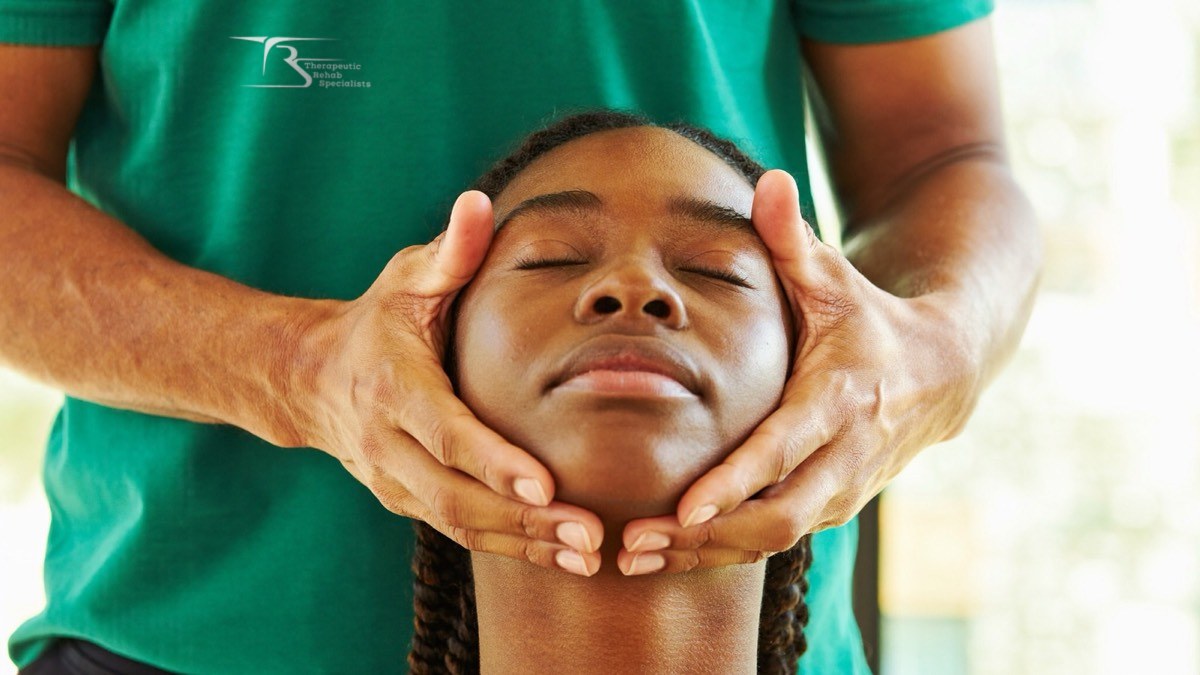
Dr. Pribila is double-certified in dry needling, and the muscles of mastication are among the places it earns its keep alongside laser. A clenched masseter or temporalis develops taut, tender bands (trigger points) that commonly refer pain into the teeth and the ear, which is why some of our jaw patients arrive after dental work that changed nothing, and a fine filament needle placed precisely into one of those bands can release it in a way that surface treatment and stretching cannot. Needling also reaches the deeper muscles on the inner surface of the jaw (medial and lateral pterygoids) and the upper cervical muscles above, which are involved far more often than they are examined.
When Your Dentist Needs to Be in the Loop
Some jaw problems are dental problems, and we will tell you so at the first visit. A jaw that clicks and intermittently locks, a bite that has visibly shifted, teeth cracked or flattened from grinding, those need a dentist or orthodontist involved, and any therapist claiming to manage all of that alone is overreaching. What we object to is the ping-pong, patients bouncing for years between a dental office that only looks at teeth and a therapy clinic that only looks at muscles. A night guard protects your enamel while you grind, but it does not release a masseter or fix the posture that loads the joint all day, any more than we can adjust how your teeth meet (occlusion). The stubborn cases need both professions talking to each other, and we are happy to make that call.
The Jaw and the Neck, Together
Effective jaw pain treatment is a plan, not a gadget. Laser therapy for TMJ earns its place inside that plan alongside dry needling, manual therapy and the postural correction that takes the daily load off the joint, and an evaluation with us looks at the jaw and the upper cervical spine together. If TMJ relief for you runs through a dental chair as well as ours, we would rather make that call in your first week than watch you discover it on your own in your third month.
Dr. Pribila is available in both our Lakeland and Brandon offices. Call (813) 876-8771 for more information and check us out on the web at: https://therapeuticrehabspecialists.com/