Why a Sore Neck the Morning After Is Worth Taking Seriously
A rear-end collision at a stoplight on Brandon Boulevard or a fender bender on the way into Lakeland rarely looks like much at the scene, and that is exactly why so many of the patients we see after a car accident waited weeks before having their neck looked at. In a typical whiplash injury the head is thrown backward and then forward faster than the muscles of the neck can brace against it, and that rapid acceleration and deceleration strains the soft tissues of the cervical spine (the seven vertebrae of the neck): the muscles, the ligaments that hold one vertebra to the next, and the small joints between them (facet joints).
It is very common for the neck to feel only a little stiff on the day of the accident and noticeably worse a day or two later, once the body’s protective guarding sets in, and patients often tell us they assumed it would settle on its own.
Sometimes it does. When it does not, the stiffness becomes a pattern: the neck stops turning fully, the shoulders creep up toward the ears, and the muscles at the base of the skull (suboccipitals) stay tight enough to start producing headaches of their own.
First, Get Checked by a Physician
Physical therapy is not the first stop after an accident, and I would rather say that plainly than have someone skip a step. Numbness or tingling down an arm, weakness in a hand, a severe or worsening headache, confusion, or pain in the middle of the spine itself all need a physician or the emergency room before anyone works on your neck. Head injuries in particular can be missed in the excitement of the moment, which is why our post-concussion program exists for patients recovering from head injuries due to sports, workplace incidents, and accidents.
Once serious injury has been ruled out, the question becomes why the neck still hurts and what it needs to recover, and that is the question we are trained to answer.
What We Look for First
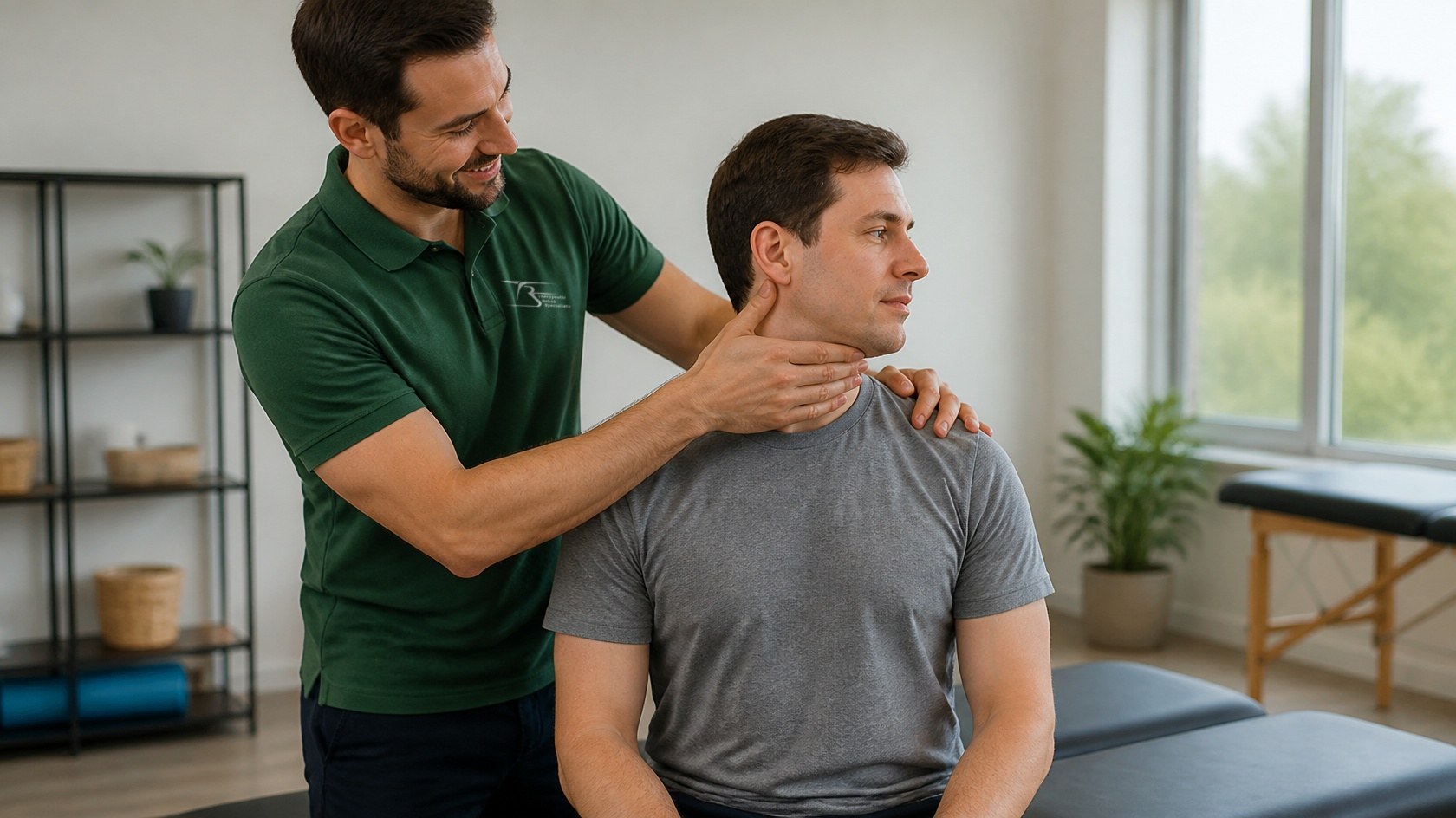
Every evaluation at Therapeutic Rehab Specialists starts with questions about how and when the pain started, followed by an in-depth muscular, joint and biomechanical exam of the neck, the upper back and the shoulders. After a collision we pay particular attention to the upper cervical spine between the first two vertebrae (C1 and C2), where restricted movement is a frequent source of the headaches and dizziness that follow a whiplash injury, and to the deep neck flexors (longus colli and longus capitis), the small stabilizing muscles at the front of the neck that tend to switch off after an injury while the larger muscles on top tighten up to do their job for them.
That imbalance is the reason a neck can feel worse months after an accident than it did in the first week, and it is the reason rest alone so often fails to fix it.
Rest calms a sore neck down. It does not teach the deep stabilizing muscles to do their job again, and that is the part of recovery that keeps the pain from coming back.
How We Treat It
Treatment is built around what the exam finds, but it generally starts with manual therapy, skilled hands-on work including joint and spinal mobilization, to restore the movement the neck has lost. Where muscles have stayed locked in a protective spasm, dry needling is one of the most effective tools we have, and I have written about how we use it in the upper cervical spine for dizziness and headaches. For patients who would rather avoid needles, EMVITAL laser therapy offers temporary relief of muscle pain, stiffness and muscle spasms through a deep warming sensation, with no downtime.
Pain relief opens a window, but it is strength that keeps the problem from returning, so corrective exercise retrains the deep neck flexors first, then the larger muscles that hold the head over the shoulders, and for that stage we often use the Total Neck Trainer, an adjustable neck harness with four rings that lets a patient strengthen the front, sides and back of the neck against progressive resistance while keeping the spine in a neutral position. We also look at how you sit, sleep and work, because the posture you return to after the accident decides how much of the progress holds.
Do Not Wait for It to Become Chronic
The patients who recover fastest are the ones who come in while the problem is still a stiff, sore neck rather than a year of headaches, and there is no advantage in waiting to find out which kind you have.
Dr. Pribila is available in both our Lakeland and Brandon offices. Call (813) 876-8771 for more information or to schedule an evaluation, and check us out on the web at: https://therapeuticrehabspecialists.com/